Friday, July 16, 2010

Got Sand?

Or should I say, do you need sand, because I have some, well, a bunch of sand in my office!  It has sort of turned into a UCFlow tradition now, but the office pranksters have done it again.  I'm not sure why I was surprised since this happens pretty much every July to me, but I have to admit... they got me good this time.  If you have no clue what I'm talking about let me explain.  Every time I leave the lab for an extended period of time (vacation, meetings, etc...) I come back to find my office 'decorated' with the latest musings of lead prankster, David Leclerc.  Now, these aren't just, "let's put a whoopee cushion on his chair" types of pranks, these take coordination and time, lots of time (I'm sure it all takes place after 5PM ; ).
In prior years, I've come back to find my office wallpapered with post-its, which sounds sort of crazy, but add to that, the fact that every single post-it had a little nonsensical note written on it.  Next was balloons.  My office was filled to about waist height with balloons - luckily they were filled with air, and not water or other types of noxiousness. The next year was aluminum foil.  My office and everything in it was wrapped in foil.  This was pretty extreme in that even the few pennies I had sitting on my shelf were individually wrapped in foil.  Which brings me to this year's vandalism.  As I approached my office on Monday morning, I started to notice a bit of graininess on the floor, still puzzled, I opened my door to find a "tropical paradise."  There was about 3 inches of sand covering the entire floor, a "palm" tree, empty bottles of corona, sand toys, and even a sand sculpture of the Eiffel Tower.
So, I haven't figured out exactly how I'm going to clean this up.  Luckily they were smart enough to put a plastic tarp over my carpet, so that should help.  But, seriously, if you are putting down some patio pavers this summer and need some sand, let me know!


Wednesday, June 23, 2010

You mean there's other analysis software besides FlowJo???

Even though a vast majority of users at U of C are FlowJo users, it doesn't mean we ONLY use FlowJo.  FlowJo does a really good job with a lot of different flow applications, but there are some things I'd definitely want to change.  So, I'm always playing around with new software, as well as revisiting old standbys:  FCS Express, VenturiOne, Kaluza, Winlist, to name a few.  In addition, there are a bunch of freeware apps that are pretty good as well:  WinMDI, Cyflogic, MFI, ANALYSE, IDLYK, and more being developed frequently.  Recently I had the opportunity to talk with Kelly Rae Chi from The Scientist Magazine, which resulted in an article featured in the most recent edition.  The piece is titled "Let the Data Flow:  Rethink your Data Analysis Tools for Flow Cytometry." It's in Volume 24, Issue 6, Page 63.

Thursday, June 3, 2010

Intellicyt HyperCyt Impressions

Well, the HyperCyt has come and gone and to sum up my thoughts in a word I can only say, Wow.  When it comes to speed, this thing is really fast.  I tried to put a bunch of different things through the sampler to try and get it to fail, but it just didn't; big stuff, clumpy stuff, small stuff, dyes, you name it.
Now, let me put things into perspective for you a bit.  We run everything in tubes manually, so to run through 96 samples I've been able to achieve a throughput rate of about 40 minutes (collecting a couple of thousand cells per sample).  My target for a sampler was to get an equivalent amount and quality of data in less than 20 minutes per plate.  By many accounts, this is NOT high throughput.  The representative from Intellicyt actually sort of chuckled at me when i was explaining this.  His idea of high throughput was collecting 384 well plates in about 6 or 7 minutes.  I certainly can appreciate the utility of this unit for something like that, but my standards of data quality are probably a bit more strict when compared to a "screening" assay.
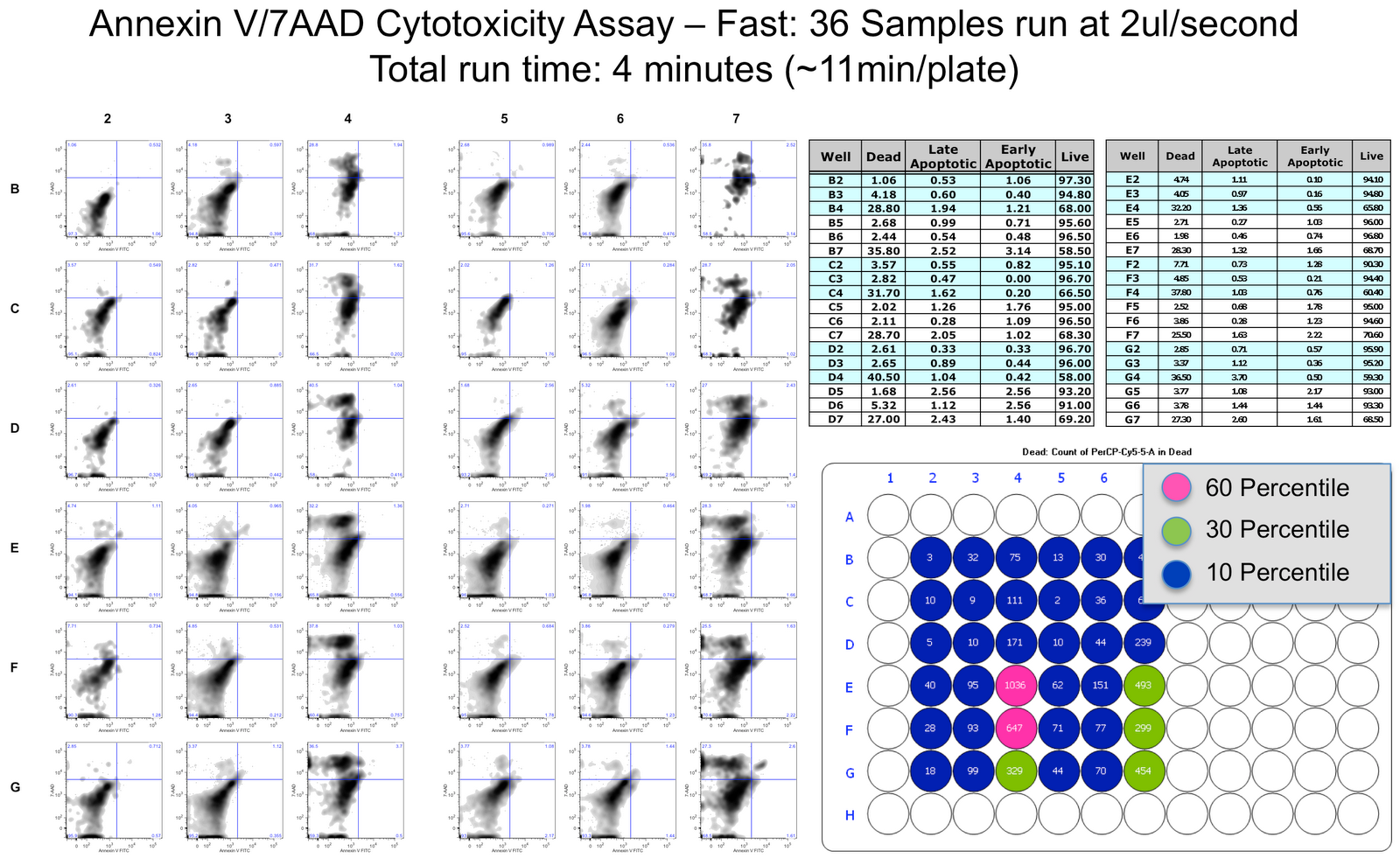
What I was really impressed with was the ability to precisely control every aspect of the sampling process such that you can go really fast, or pretty slow if you wanted to.  What I am showing here is a comparison of the same exact plate run at a "high" speed (~11 minutes per 96 well plate) and at a "low" speed (~27 minutes per 96 well plate).  It is a simple Annexin V FITC vs. 7-AAD cytotoxicity assay, that is comparing the affects of a drug on the cells.  As you can see, there is no appreciable difference in the two, and they both are the same as when I ran these samples manually in a tube.

Other things I ran were two big cell lines (one GFP, one RFP) mixed together to look at the potential increase in coincidence events (double positives) when going at high rates.  When I ran the sample manually in a tube, I saw about 0.5% double positive cells.  When I ran them through the HyperCyt at the higher flow rate, that double positive population shot up to 1.6%, and when I ran it at the slower flow rate, it was about 1%.  The reason this happens, as I'm told, is that when the unit sends the bolus of cells into the cytometer, the cells tend to accumulate at the leading edge of the bolus, so you get a high concentration of cells right in the beginning of collection, thus leading to higher coincidence.  In fact when I looked at the formation of coincident events versus time of a single collected sample I saw exactly that, all the double positives were detected in the 1st second or so of collection, then after that, it leveled out to the 0.5% seen while running the samples manually in a tube.
One other thing I was concerned with was the residual dyes left over when rinsing between samples.  To test this, I ran alternating samples of PI stained CENs and DAPI stained CENs.  I first ran it with no wash to show that the probe itself may be transferring dye from well to well (which it did).  Then I ran the samples with a wash in between collection and then there was no increase in PI staining of the DAPI CENs and no increase in DAPI staining of the PI CENs.  This, along with multiple other tests run with beads put me at ease as to the capabilities of this instrument as a multi-well plate sampler, not just a high throughput screen tool.
So, will I get one?  Likely, but possibly in the form of a Accuri/HyperCyt combo ala what was displayed at the CYTO 2010 meeting.  This is a new product from Intellicyt, which they're calling the HTFC (High Throughput Flow Cytometer).  Here's a link to the info on that (warning, this is a link to a pdf, so it will automagically start downloading to your computer; not to worry though, it's safe).

Core Fair Today!!!!

The Office of Shared Research Facilities is hosting it annual Core Fair today from Noon to 2PM in the GCIS atrium.  This is your chance to visit with all of the ~25 different core facilities on campus to find out what's new and exciting in their labs.  The flow lab will be present and is eager to share with you our new technology and services.  We'll be highlighting the ImageStreamX, of course and all the neat things you can do with that instrument.  But, we're also trying to spread the word about our Drop-Off Service and our forthcoming analyzer, the BD LSRFortessa.  Last, but by no means least, we'll be letting people know about our exciting news regarding the MoFlo.  (Drum roll, please) It has been a long time coming, but we've finally secured some funding to get our MoFlo upgraded to the MoFlo XDP package from Propel Labs.  This will definitely breathe new life into our dying sorter.

Saturday, May 22, 2010

Qdots: they're not just for lighting up your antibodies any more

Get this; a company (spun-off from Fujitsu) has successfully made a green emitting laser using Quantum Dots. The company, called QD Laser, Inc. (how original) created a quantum dot semiconductor crystal that emits at 1064nm. A quick frequency doubling yields the 532nm laser line we all know and love. Now, they certainly aren't making this for the biomedical research crowd, but hey none of the tech we use today was developed for flow cytometry. It's the trickle down effect that gives us all the great gems. So, you're probably saying, who cares, a 532nm laser, we have a ton of them. Well, besides this being made from a Qdot, it also is super low-power consuming, and it is tiny; see the pic below. QD Laser envisions these lasers along with already available red and blue lasers as the projection source of an RGB miniature projector that can be embedded in smartphones. However, I'm envisioning these lasers on my handheld cytometer.

Wednesday, May 19, 2010

HyperCyt Demo 5/25, 5/26

We will be demonstrating a new 96/384 well sampler on the LSRII-Orange next week. To introduce the platform, we will host a seminar on Tuesday, 5/25 at 10AM in Cummings Room 119. On Wednesday the 26th, we are looking for people who wish to try out the sampler using their own samples. Since this unit will be installed on our LSRII-Orange, please be aware of the lasers/filters on that specific instrument. Here's a few stats on this system. More info can be found on their web site @: http://intellicyt.com/products_hypercyt.php


-Max speed: Full 96 well plate in 2.5 minutes, Full 384 well plate in 10 minutes

-Sample Volume: as little as 2ul with zero dead volume, and as much as a full well

-Can be connected to a variety of cytometers

-Carryover in High Throughput Mode can be 1-2%, but inter-well washes decreases carryover to less than 1%

If anyone else out there has one of these, I'd be interested in your thoughts as well. We've used the BD HTS system on a FACSCalibur with not-so-great results, so are looking for something more high throughput, and more stable.