Thursday, March 31, 2011

Sort Schedule Changes: The Who, What and Why.

Let's start at the beginning.  Back in the days of the FACStar Plus and water cooled gas lasers, we would begin accepting sort reservations at 10AM.  This allowed us to get in at 9AM, warm up the lasers for 30 minutes, get the fluidics going, and have everything running smoothly by 10AM.  We typically did 1 or (on a good day) 2 sorts, which lasted 2-4 hours going at a rate of about 5000 events per second.  Adding the MoFlo in 2001 allowed us greater throughput by allowing us to run at 10's of thousands of cells per second, but we still needed a good amount of time to get started in the morning so the I-90s could warm up and the fluidics could stabilize.

As word got out about sorting applications in general, the sorters became busier and busier; so much so, that we traded in the old FACStar Plus, and traded up to the FACSAria.  Around the same time, we retired our water cooled gas lasers, and outfitted the MoFlo with the solid state Lyt-200 from iCyt.  The ease of setup on the Aria, and the nearly instant-on of the solid state lasers made getting started in the morning much easier.  Slowly but surely, we allowed earlier and earlier sorts until we officially added the 9AM - 10AM slot on both sorters.  The increased capacity kept up with demand for a period of time, but soon even running both sorters 9AM - 5PM wasn't enough.  We also saw that the afternoon slots were filled weeks in advance, and the unfortunate few who had to book sorts last minute were stuck with the 9AM slot, usually forcing them to get started in the wee hours of the morning.  In an attempt to solve this problem, and position ourselves for an S-10 application for a 3rd sorter, we added a 5PM - 8PM "late night" sorting slot on Tuesdays and Thursdays, and had one of the operators work a 12PM - 8PM shift on those days.  These slots were gobbled up instantly, and soon became a favored slot amongst the users.  Still struggling with overall capacity, the cancer center stepped up and helped us purchase another sorter, the FACSAria II.  So, now we had 3 sorters available from 9AM - 5PM Monday thru Friday, and the FACSAria II available an additional 3 hours on Tuesday and Thursday evening.  This setup served us very well for a couple of years.  Along the way, we still saw that afternoons filled up very quickly, and the 9AM slot was still being used for last minute sorts, or GFP cell line sorts.

So, we decided to take a look at usage more closely, and query our user group about the possibility of opening more 5PM - 8PM slots.  Of course everyone thought the idea of more evening slots was great, but we needed some data to support this change.  The figure below shows the frequency in a year of a sorter being used at each hour of the day.  It is separated out for each sorter.  The blue line shows what percentage of available time the sorters (as a whole) are being used.  As expected, the afternoon slots are used 70% of the time, while the 9AM slot is reserved only 25% of the time.  Also, the 5PM - 7PM slots are used 60% of the time, even though the actual number of sorts taking place appears low.  The 25% number at 9AM is also a bit misleading.  This represents that hour being booked, but I can tell you, it is very rare for someone who books a sort from 9AM until 11AM to actually show up at 9AM, and the longer that reservation is, the later they show up.  So, the actual usage of the 9AM hour is probably much lower.  I'd estimate it at 10% or so.  So, instead of sitting around waiting for the 9AM sort to show up, we could utilize that time better by getting QC done on our army of bench-top analyzers, or allow for more stabilization time of the sorters to get even better results.  So, beginning in April, we will have new sorting hours as follows:  M - F 10AM -5PM, and additionally on one sorter, 5PM - 8PM M - Th (no one wants to sort until 8PM on Friday night!).  The number of available hours per week is still about the same.  Previously, we offered 121 hours of capacity each week, and now we're offering 117 hours. Our actual weekly usage is about 70% of that anyhow, so we feel the new hours are plenty for the current demand.  In addition to all this, we have been aggressively pursuing users who are frequent FACSAria users to get trained and run their own sorts.  We have half a dozen users who already do this on a regular basis and will be tapping a few more competent users in the near future.  We feel this, along with the increased evening hours, and the removal of the 9AM slot, will maximize the efficiency of our sorters and allow more convenient access for our users.

Wednesday, March 23, 2011

Getting in tune with the Attune

An updated review of the Attune Cytometer, dated October 2012 is now available:  You can reach that post here:  http://ucflow.blogspot.com/2012/10/life-technologies-attune-cytometer-deja.html

EDIT 2:  I've met with some folks from Life Technologies and they feel the instrument that was set up in my lab for demo was not properly aligned, and so I've agreed to give it another try.  I'm not sure if I'll use the Violet/Blue combo or the Red/Blue system, but either way, I'll post the results and reference back to this post when I have them.

EDIT:  Regarding the statement below in the Optics section, "I have not received information that I requested yet, but the 'PMTs' do not appear to be 'PMTs'."  I have heard back and there are, in fact, PMTs in the system.  It's just not obviously visible when you simply open the hood.  They are the Hamamatsu H10720 Series, and in the far red channel, they are using the Red sensitive "-20's"

You've probably heard about the novel approach to sample focusing on the Attune, and you've probably even read through some of the marketing materials distributed by Applied Biosystems (Life Technologies).  So I won't go through all those features in detail, but I will share my impressions and tell you what it means for your data in the end.

Briefly, the Attune is a 2-laser, 6-fluorescence detector small-footprint cytometer.  The fluidics are syringe pump driven (as opposed to pressure-driven), and it's in the focusing of the cells through the laser interrogation point that is unique.  Instead of hydrodynamic focusing applied by a sheath fluid (such as PBS), the Attune uses an acoustic wave form to push the cells into the center of the stream, forcing them to line up in single file.  One advantage of this is the small amount of sheath buffer you need to put into the system (roughly 1L per day compared to 6-8L for a hydrodynamically focused system).  Another benefit is the ability to push through large quantities of sample fluid per unit time.  Whereas a pressurized, hydrodynamically focused system might top out at about 200ul/minute, the Attune can achieve volume flow rates of 1000ul/minute.  It can also maintain the CV of the fluorescence signals even at high flow rates. Lastly, the system can actually change how fast the events are passing through the laser interrogation point.  They have a standard, and high-sensitivity setting, which tells the system to pass them through at the normal rate, or at a slower rate, respectively.  The idea is that if the cells pass through the lasers more slowly, the fluorochromes will emit more photons, allowing you to detect lower amounts of fluorescence.

Optically, the system has a 20mW 488nm laser and a 50mW 405nm laser.  There are no other options for laser lines at this point.  3 of the fluorescence detectors are dedicated to the blue laser and 3 to the violet laser, and they're set up for FITC, PE, PerCP/PECy7, and PacBlue, Qdot 525, and Qdot 605/PacOrange.  The filters are easily changeable, and there's even a storage section for spare filters (how nice!).

I'll try to break up my comments by instrument components.  I will say, many of the complaints I had regarding the software were said to be fixed in an upcoming release, but I will give my opinions based on the instrument I evaluated (03/09/11).  Also note that the instrument was installed by a field service engineer and passed their performance and tracking protocol (similar to CS&T a la BD).

Fluidics:
1.  Being a syringe pump system, you need to specify how much volume you wish to analyze before you even put on  your sample.  Of course, you can always add to your sample acquisition, but it doesn't have the 'free-run' capabilities that a pressurized system has.
2.  If you tell it to take up 500ul of sample, and then you get enough data, or you want to just take your tube off, the remaining sample in the line goes to waste, and not back to your tube.  So you could foresee a possible loss of sample in some situations.
3.  The dead volume is huge!  200ul of your sample is taken regardless of how much sample you wish to analyze.  So, if you want to analyze 100ul, you need to have at least 300ul of volume in your sample.
4.  It was really nice being able to put on different sizes of tubes and not have to worry if they're the right kind or cracked.
5.  As advertised, the CV's are really low even going at high sample throughput rates.
6.  Although they claim they can run at rates of up to 20,000 events per second, there is no report of the coincident rate going at that speed.  A high abort rate would obviously have an impact on detecting and counting rare events.  Even on our systems with zero "dead time" we still see coincident events to some degree.
7.  Although in theory we'd expect the high sensitivity setting (i.e. slowing the cells down in the interrogation point) to increase resolution, my tests did not show any improvement with stained beads (data not shown).  It's likely that the components that contribute to autofluorescence also increase their intensity so the separation between positive and negative doesn't really change.
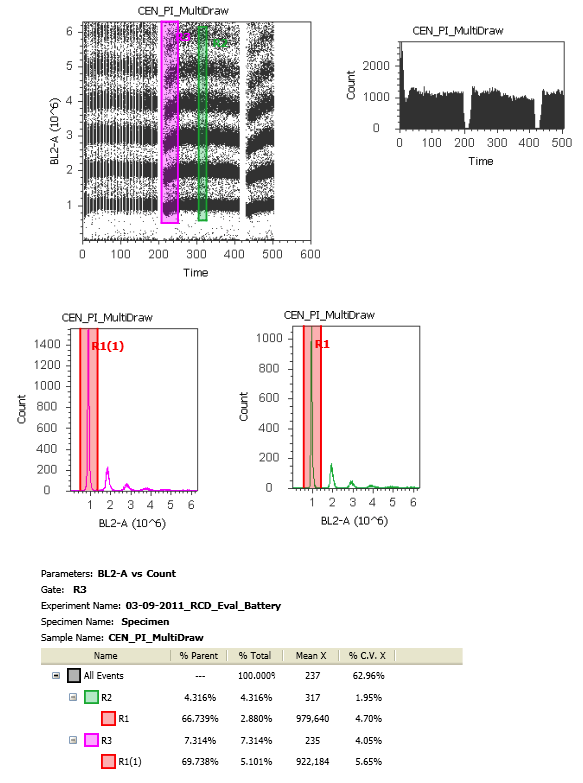
8.  When you tell the system to collect 2mL of sample volume, it does so in (for example) 500ul 'draws' from the tube, i.e. 4 draws from the sample tube.  The reason is that they don't want to have all that volume sitting in the tubing waiting to go to the flow cell.  The result is that you end up having these pauses in acquisition while the system refills the tubing.  Because of this, when you start collecting your sample again, the core stream has not completely stabilized leading to a decrease in fluorescence and a widening of the CV (Data Below).  In order to get rid of this data, which will surely mess up your analysis, you'd have to go to each point where it drew more sample and exclude the first few seconds of collection until the stream has stabilized.  It's an easy enough fix to make the software ignore data being collected for a few seconds every time it draws, and hopefully they'll implement that fix.

Software:
1. IT'S FREE!!!!!!!!
2.  The overall look of the software steals a page from Microsoft Office, with a prominent ribbon at the top for common tasks, and lots of right-click functionality.  Users should feel comfortable here.
3.  Similar to FACSDiVa software, there is a Experiment Explorer (Browser) that displays your experiment, all the tubes in the experiment, and the settings/plots saved within.  There was some confusion in terms of things being applied globally (to the entire experiment) or to an individual tube. Again, similar to DiVa, it's not always obvious if something is applied globally/individually, and how to change that status easily.  Lastly, it also resembled the Gallios software in that if you made a change to the plots/regions, you had to click save or else you'd lose those changes when you switched tubes.
4.  Gating was somewhat cumbersome.  Changing hierarchy of the gating structure after you've created gates was difficult and not intuitive.
5.  Displaying large numbers of events was slow and jerky.  There was this weird need to press 'F5' to refresh plots with lots of data point.

Optics:
1.  I have not received information that I requested yet, but the 'PMTs' do not appear to be 'PMTs'.  There is definitely not a vacuum tube with anode, dynodes and cathode like you'd expect to see.   It looks like some sort of silicon diode, but like I said, I haven't heard yet.  This could contribute somewhat to the performance I observed.
2.  I really appreciate the extra slots for filters on the instrument.  I'm a big believer in spare filters, but I can never seem to keep track of them (just look in our MoFlo room).
3.  Although the laser powers seem appropriate, there was no mention of how much of that light actually makes it to the flow cell.

Electronics:
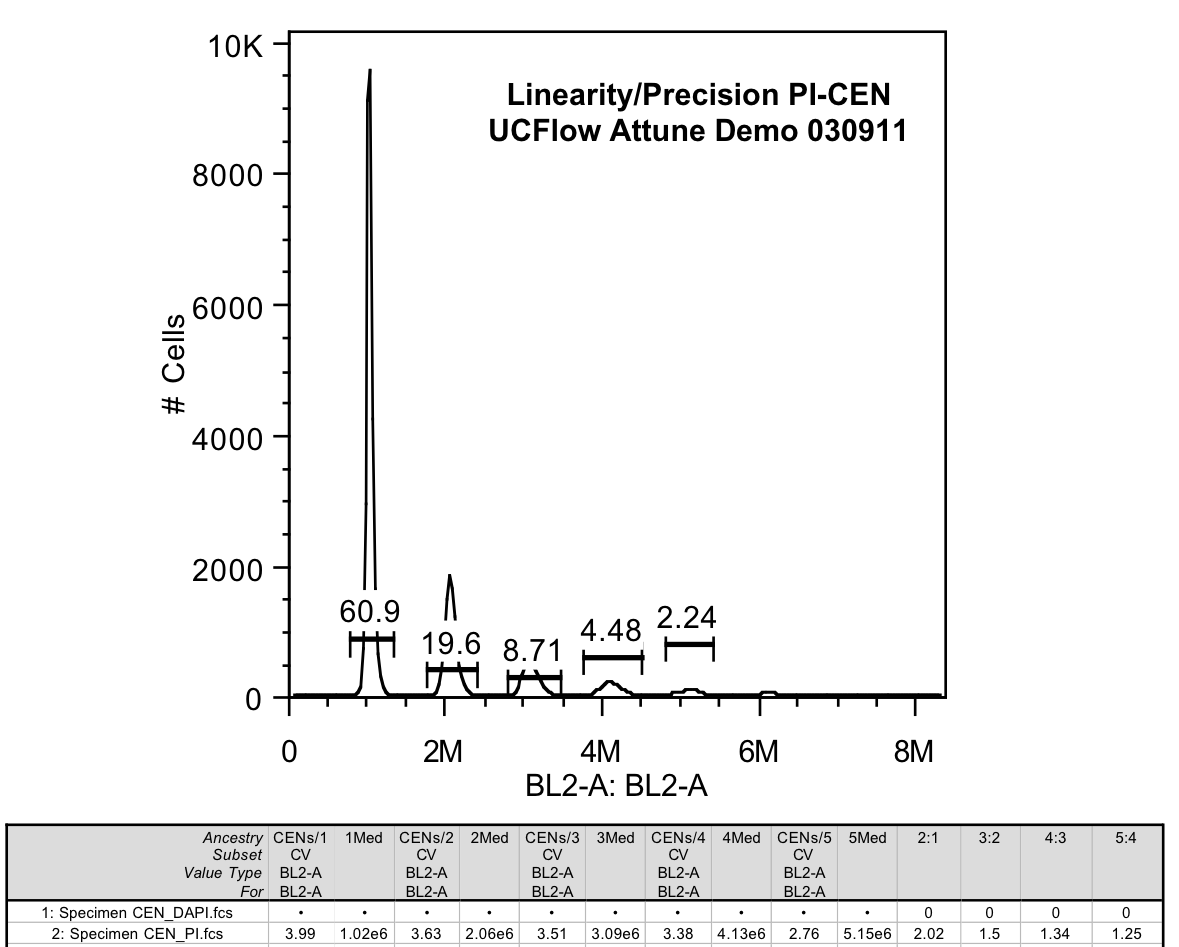
1.  Testing of linearity across the 6-log scale was good (CEN data below)
2.  23-bit ADC conversion yield 8.4million channels across 6 decades, which generates approximately 76 bins in the 1st decade.  This seems pretty good, and would allow for resolution of closely related populations on the low end of the scale, but that's not really what I saw.  I was able to see some 'picket fencing' which tells me that the noise of the ADC makes the bit conversion probably closer to 20 bit, which yield about 9 channels of resolution in the first decade.  This is speculation on my part since I do not know (yet) what ADC they're using, and what the noise level of that ADC is.

Data:  For this I ran my standard battery of tests, the results of which can be found below.

8-peaks:  Testing the overall alignment and diagnose background problems due to laser light.
Assessment:  8 peak resolution off the blue laser was not as good as other 'full-size' cytometers (i.e. FACSCanto-II, or Gallios)

CEN Linearity:  Using PI stained (and DAPI stained, but not shown) CENs.
Assessment:  Linearity was good along all of the scale tested.
Dim Population Resolution:  Here we have Antibody binding beads from Bangs stained with a FITC, PE or PacBlue antibody to demonstrate the ability to resolve increasingly dimmer fluorescence from background.  The more separated the peaks, and the further from the blank the better the resolution.
Assessment:  The FITC channel (BL1) seemed to be the worst of the 3 tested.  The PE channel was ok, and the PacBlue Channel (VL1) was pretty good.  To see comparable data on another instrument, check out the same data on the FACSCanto-II


Stream Stability:  For this, I tried to have it draw sample multiple times while looking at PI fluorescence in linear.
Assessment:  As you can see, the fluorescence dips down every time this fluidics draws more sample.  This leads to an overall higher CV if you don't time gate the data.  You can easily see this by comparing the purple box at the beginning of acquisition post draw and the green box that's mid-way through that collection.  

Final Thoughts:  Like many of the smaller sized cytometers, the Attune will probably handle most of the general types of applications, but will not compare to high-end cytometers in its ability to detect dimly stained populations, even using its High Sensitivity mode.  The real advantage is its ability to push large amounts of volume of a relatively dilute sample through the instrument without increasing CVs of the populations.  For example, a lyse/no-wash rare event blood tube.  In most every other case, we would simply concentrate the sample by spinning it down, and run it in a similar amount of time as what can be achieved on the Attune.  The overall look and feel of the software is fairly polished.  If they're able to correct a few major things (like return unused sample, not store data during stream restabilization, allow for a quicker refresh of data on the screen, and get rid of the F5 necessity) with some software changes, it will be a much better instrument.  The lack of a red laser, or laser options is a real hurdle for many people, especially those with a large stock of APC and APCCy7 antibodies, and could be a deal-breaker for many labs.  It would also be nice to have a higher powered 488nm option as well.  This, along with the whole 'PMT' issue might lead to better resolution in the FITC channel, which was especially poor.


Thursday, March 10, 2011

Just when I thought I was out...they pull me back in.

I'm speaking, of course, about BD and the FACSCanto platform. Now, if you know me and have talked to me about flow cytometers, you know I haven't been too kind to BD and the FACSCanto-A. We have, and continue to, battled with problems on these instruments. It doesn't help much that we have hundreds of users running all sorts of who-knows-what through the instruments. But then again, our LSRII's never break-down, our 15 year-old FACScan and 10 year-old FACSCalibur never break on us and they get just as much use. Recently, however, I happen to have the privilege of running a FACSCanto II with an HTS. We've had it in the lab for a few weeks, so I've been playing around with it trying my darndest to break it, without success. It's definitely not a fair comparison as far as the use and abuse our other cytometers deal with, but I've tried to run some unfiltered chunky samples on it a few times, and it recovers well. The HTS has been running as well as could be expected; so well, that we're now putting one on our Fortessa. There are two other things on the Canto-II that have really caught my attention. The first thing is the overall fluorescence sensitivity and resolution. It certainly ranks among the top instruments I've ever tested. I ran my standard battery of tests on the instrument (dim population resolution, linearity, dynamic range, and precision) and the FACSCanto-II excelled in all respects. I'll highlight a few of these tests with some figures below. Before that, I want to document just how awesome it is to be able to put on a regular 12x75 tube with about 100ul, and be able to analyze almost all 100ul out of the tube. The way that the lever pushes the tube all the way up so that the probe is nearly hitting the bottom is awesome. That, combined with the absence of a DCM sleeve on the SIT makes this possible.  Dead volume is about as minimal as can be for a tube loader.

Figure 1 below simply shows some antibody binding beads from Bangs stained with a CD4 antibody coupled to either FITC, PE, or eFluor450. The lowest stained peak represents a binding capacity of ~3000 antigen. To put that into perspective, CD4 on human Tcells is expressed at about 50,000 antigen. So, you can see that something with 10-fold less antigen density can easily be separated from background.


Figure 2 is simply displaying 8-peak bead data.


And Figure 3 is showing PI stained CEN's to show precision (% CV of the 1st peak) and linearity peak-to-peak ratios.

Monday, February 7, 2011

A 19.2V Drill with every sorter purchase?

As you've probably heard, Beckman Coulter put itself up for sale last year, and now it looks like they will be purchased by Washington based Danaher Corporation. Danaher is a conglomerate that owns the Craftsman hand tool brand as well as businesses in electronic testing equipment, dental equipment, and monitoring products. They also own the microscopy company Leica. What does this mean for the flow cytometry world? Probably not much, but the extra capital available from Danaher could only help R&D for flow cytometry, right? Time will tell. It seems like the MoFlo just can't find a stable home. Ever since Cytomation was acquired by Dako, the MoFlo has been passed around like a plate of crudités at a 6 year old's birthday party. My advice to Danaher and those making the transition from Beckman Coulter - forget everything you think you know about flow cytometry, come talk to the folks in trenches, and design a new instrument that's more than a "me-too" product. Good luck! Here's Beckman-Coulter's statement. And here's what Danaher has to say.

Friday, January 7, 2011

The Beckman Coulter Gallios and Translational Research at UCFlow

Have you ever had a frantic MD fellow rush into the lab with a rack full of tubes saying, "A patient just showed up and I have these samples that I need to run now.  Is there any instrument time available?"  A couple of years ago, I would have said no, but this scenario has become more and more common around here.  As the lines between the clinic and the research bench become ever more blurred, the needs of the community in a research medical center begin to expand.  The major variable in this whole arena is a fickle creature we like to call a human being.  You see, unlike mice, they don't get sick when you tell them to and you can't force them to fit into your schedule, so you have no choice but to modify your service to accommodate the unpredictable nature of clinical research.  The perceived lack of access to the core by clinical researchers has also been the driving force behind individual researchers' desire to work outside of the core and invest in their own instrumentation.  In principle, I don't really have a problem with this, but as a business model in a University, I think it's very inefficient.  We have spent years perfecting our craft in the flow lab.  In fact, we possess a collective 25+ years of experience operating, maintaining, and troubleshooting flow cytometers and sorters.  It's difficult to see why someone would want to side-step all that knowledge. But, I digress...

At the same time we were scratching our heads as to how we could offer this group of clinical researchers greater access to flow instrumentation while not taking away capacity from our large and active group of basic researchers, we were evaluating and testing an instrument called the Gallios from Beckman Coulter.  The Gallios is a fine piece of hardware.  It has some of the things you'd expect of an analyzer from Coulter, flashing lights (like the FC500), a carousel loader, a fairly locked-down box.  But it also has some new/unexpected things.  They took a cue from the success BD has had marketing the "Octagon" and came up with their own design called the "Boulevard."  It basically serves the same purpose; bounce light off filters, don't transmit light through a bunch of filters.  They deliver light to the Boulevard via a fiber cable coupled to a pinhole for the appropriate laser - pretty much the same as a BD instruments.  Another interesting optical component is the laser launch module.  The solid state lasers shoot their beam into a steering tower that has motor controlled micrometers which allows for remote alignment.  Laser light to the flow cell is delivered in air, not fiber, as to maximize energy at the point of illumination.  These two things make the Gallios pretty much optically on par with an LSRII.  There's a unique FSC detector that tries to look at different angles of refraction to better resolve small particles, but since I don't care too much about that, I'll skip it.  The thing that sets the Gallios apart from the DiVa setup is in fact the electronics.  I won't attempt to explain the architecture of both platforms here, but will simply cut to the chase.  More bits of resolution across 4 or 5 log decades leads to better resolution of dimly stained cells when comparing two instruments that are optically pretty similar.  So, in my testing, I was able to resolve dim stuff from background better on the Gallios than on my LSRII, and the reason that's the case, in my opinion, is the higher resolution electronics on the Gallios (especially when comparing the 1st and 2nd decade of the scale).  The last thing about the Gallios was its optical stability. Again, comparing it to our LSRII, which we tweak the alignment more frequently than we'd like to, the Gallios is rock solid.  It probably compares pretty well to the optical stability of a FACSCanto-II (as I've heard from others who have one - I only have FACSCanto-As, which I don't like at all).  But, even as of yesterday, about 10 months after install, the beads look exactly the same.  I've never seen any of my instruments not need a little tweak of the alignment after 10 months of use.  That was impressive.

So, I had an instrument that seemed to work really well for us, and I had a problem with capacity for last-minute clinical research use.  Are you thinking what I'm thinking???  You got it, kill two birds with one stone (figuratively of course; I don't condone the practice of killing anything with stones).  So, I wrote a proposal to the department to pitch the idea of buying the Gallios and opening it up to our clinical research group only.  This would free them from worrying about having time booked in advance on one of our instruments.  In fact, booking time on the instrument wouldn't even be allowed more than 48 hours in advance.  Thankfully the department liked the idea, awarded us the money, and we're developing the usage plan now to offer this service to our Translational Research groups.  To sweeten the deal a bit, we offered to expand our Drop-off service so that clincian/researchers who did not have a lab full of techs could simply drop the samples off to us and we would run them on the Gallios and give them back a preliminary analysis of the data.  Win-Win-Win for all.

Tuesday, November 9, 2010

Compensation is infiltrating my dreams.

I've been composing this post in my head for a couple of weeks now, but have been too busy to sit down and write it, so it shouldn't really surprise me that it popped up in a dream.  However, a new twist was added via my unconscious mind (which I'll get to later).  So, the original post was all about how I've pretty much given up on compensating using cells, and if you're not using beads, then you're pretty much setting yourself up for compensation failure (unless of course you're using things like PI, or mCherry, or the like).  I mean, the whole point of 'autocomp' is to take the subjectivity out of compensation, and using objective mathematics to correct for fluorescence spillover.  However, every single time I've done autocomp using cells, it just doesn't look 'right' and I end up tweaking the values just a little bit.  I've come to terms with this fact, and have pretty much settled with this sub-par situation.  But, if you're trying to teach someone about compensation, and you introduce this 'autocomp' feature, it makes for a pretty awkward conversation when you then go on to say, "Well, just adjust the values a little bit until it looks right."  So, I typically recommend people do their compensation with beads.  For many of my users, the thing that prevents them from doing this is cost, or maybe a bit of skepticism in changing the ways they were taught to do their staining.  The reasons why compensating using cells doesn't always work are many, but let me just outline a few for you here.

1.  Insufficient frequencies of both positive and negative fraction to make a statistically significant regression of means.  If in your stained cell sample, you only have a 0.1% positive fraction, the mean of that population in the spillover channel will not reach a high enough statistical significance until you collect millions of cells.  No one is going to collect millions of cells on their single stain control.  This also holds true when all your cells are positive for your single stain control, and you have a really low negative (or low) population.

2.  Poor resolution of the positive fraction.  Sometimes you will not have a clear positive population, so making a gate around the positive fraction for performing compensation is difficult.  If you end up encircling some of the high autofluorescent cells that you mistakenly call positive, your compensation will surely be off.

3.  Non-linearities at the extremes can lead to inaccurate compensation.  If you're compensating using an unstained (or negative) fraction that is at the very low-end of the scale, or if your positive fraction is at the very high-end of the scale, you're likely using a data point in the non-linear range of the log scale. Since compensation algorithms are basically relying on the fact that your range of analysis is linear, you're going to run into lots of problems if you're using "unstained" cells as your low-data point, or really bright cells as your high data point.  Side bar:  Yes, I know, your comp control should be at least as bright as your sample staining, blah, blah, blah.  However, the only reason why this is the case is because of non-linearities at the very high end of the scale.  If all your staining fell within the linear portion of the scale (let's say 1.0 logs to 3.5 logs), then this isn't necessarily a problem.  You can take any two points within that range, and create a regression line that will model the entire scale.  No-scale is linear enough, especially at the extremes, so the 'rule' of a maximally bright comp control needs to be adhered to.

4.  Mismatched autofluorescence between positive and negative.  If I stained my leukocyte prep with a monocyte marker (CD14, for example).  All my monocytes will be positive.  For this single stained comp control, what should I use as my negative?  Many people would simply use the negative lymphocytes or granulocytes, and many people would end up with a poor compensation matrix.  For channels where autofluorescence is a factor (mostly the green/yellow detectors off the blue and lower laser lines), the positive fraction's autofluorescence should match the negative fraction's autofluorescence.  This is, evidently only necessary when you're using cells for compensation, and you have a mixed cell-type sample.

So, there are certainly lots of pitfalls when using cells for compensation, which is why using beads is a good idea.  To solve many of these issues, simply using an antibody capture bead at two fluorescence levels should do the trick.  You'll notice I said two fluorescence levels, and not one positive and the 'blank' bead.  Using the blank bead can lead us into issue #3 above, so I prefer to use the bead at a saturating level of antibody and maybe 100-fold less, to create a high and low peak.  In the end the peaks will fall around the 3.5 decade range and 1.5 decade range.  Use these peaks as your 'positive' and 'negative' values in your favorite autocomp program, and voila, perfect compensation.  Of course, these beads are run at the appropriate voltage that is set up according to your cell type.

But, what about the twist?  The twist is, that you don't need to only use beads as your capture matrix.  You could use cells!  I know, I know, I just went on and on about NOT using cells, now I'm telling you to use cells, but wait, let me explain.  Take a thymus, get all your non-tandem antibodies in CD4, stain them at two concentrations, fix them, and stick them in the fridge.  You now have ready-made compensation controls that are much cheaper than buying capture beads.  Why thymus?  They're the closest thing to beads; pretty much homogeneous, so we don't have to worry about autofluorescence mismatch, they're almost all CD4 positive, so that makes it easier to create two nice peaks, and you can get a boatload of them from a young mouse.  On top of all this, we gain the ability to use other things besides antibodies.  You could stain them with many of your dyes for a comp control, PI, DAPI, CFSE, etc...  Something you can't do with beads.  For tandems, I'd stick with capture beads.

Ok, there you have it.  If you've made it this far reading through all my gibberish, let me know what you think.

Friday, October 1, 2010

MoFlo Upgraded to XDP, plus a couple new laser lines.

Ah, the MoFlo - what a fine piece of craftsmanship!  I started my relationship with the MoFlo (Formerly of Cytomation, Formerly of DakoCytomation, Formerly of Dako, Currently of Beckman-Coulter) in the year 2000.  We had many great years together, but our relationship was getting a bit stale.  You see, there was this fancy new gal in town call the Aria who lured me into her web of seduction with promises of 'turn-key' operation, and I bit!  I soon realized however, that the grass isn't necessarily greener on the other side, and re-visited the rock-solid usability of the MoFlo.  In recent years, the MoFlo started showing its age.  I have to admit, part of the issue was a certain level of neglect and abuse on our part, but hey 10 years in instrument years is like 80 in people years.  And so we came to a fork in the road, and as with most things in the technology area utilizing 20 year old components, we had to decide, pull the plug or pursue the upgrade path.
When I was contacted by the folks at Propel labs (who, evidently are a group of people from the original Cytomation company) that there was an upgrade path to the XDP electronics for the legacy MoFlo, I was thrilled.  After about a year of begging for money from anyone that would listen to me, I finally secured the funding and was ready for the upgrade.  So, why upgrade to XDP instead of buying a new sorter?  Well, first of all, it was a financial thing.  The cost of an upgrade is about 1/4th the cost of a new sorter.  Secondly, the fluidics on our MoFlo are uncannily stable; who knows if we'd strike it rich again with a new sorter.  You may also be asking, what's so great about XDP?  Well, I'd never be able to explain with such elegance as Dan Fox could, so all I can say is track down the white paper Dan wrote, read it, then pick your lower jaw up off the floor.  The big lure for me (besides the obsolescence of parts for the legacy MoFlo) was just the fact that we'd be able to operate with no/low hard aborts similar to the Aria, which, when paired with the higher number of droplets a jet-in-air can achieve, should allow us to sort faster and maintain high yields and purity. With our XDP upgrade, we also had all our PMTs changed, and threw on two new laser lines to boot.  - Side note - We had one of these co-lase towers installed on our MoFlo, which is also a product of Propel Labs, that basically combines two laser lines so they can be run colinear into the 3-pinhold MoFlo setup.  We chose to put on a UV and Red laser and run them colinear through the co-lase tower.  This now gives us a 4-laser MoFlo (355, 488, 561, and 640) - End Side Note -
The remains of the MoFlo after the tear-down
As far as the actual upgrade goes, the install went pretty smooth.  It took 2-3 guys about 3 days to completely tear down the instrument to basically an empty table, and then install the PMTs, electronics, the touch-screen panel, and the computer.  As with most installs/upgrades, we did have a couple hiccups, but they were taken care of immediately.  I guess that's one good thing about working with a smaller company like Propel Labs.  They can't afford to lose any business, so customer service is automatically very good.

We've been using the XDP now for about a week, and things have gone pretty well.  We're still getting use to the touch-screen interface, and some of the new things in Summit, but overall, I'd say we made the right decision, and hopefully the MoFlo can dutifully give us another 10 years of service.

Once we've gotten into a rhythm on this thing and really test the bounds of speed, I'll post some data.  But for now, enjoy a pic of the finished product below.

The upgraded MoFlo XDP in all its polished glory!